
Dewey has a very long history.
At 142 years old, it has outlived the paper roadmap, boom boxes and rotary phones! Imagined by Melvil Dewey in 1873 and published in 1876, there is even a National Dewey Decimal Day celebrated in the United States on December 10, the country of his origin. Still, the debate for many of our public and school libraries for some time now has been, do we ditch Dewey for something more modern?
What is it and why has it lasted so darn long?
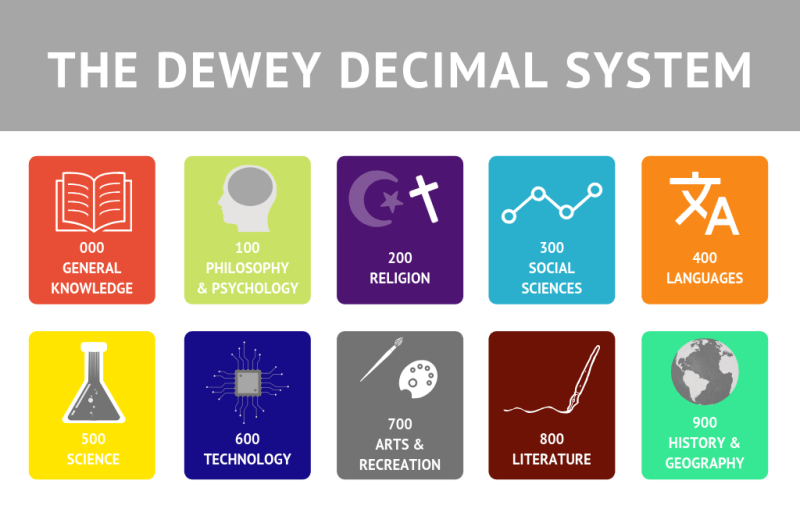
DDC has 10 broad classes under which each title is placed. Source link. For an extensive reference guide, also see http://bpeck.com/references/DDC/ddc.htm
Before the invention of Dewey Decimal Classification (DDC), libraries gave books a permanent shelf location related to their order of acquisition rather than topic. The DDC allows for “relative location” and “relative index” using an Arabic numbers system for flexibility.
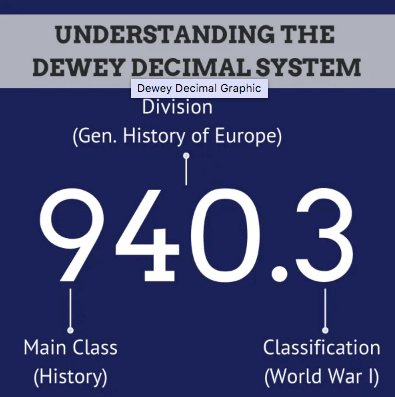
Dewey devised this system with the plan to “scatter books by treatment“. He created ten broad classes, under which each catalogued work is placed. From these classes (or subject areas), works are further classified using decimals. This kid-friendly visual shows how it works:
DDC is the most commonly used system worldwide. Since its original publication, it has been updated twenty-three times. “One of the most important arguments in favour of DDC is its position as the most widely applied scheme in the world.” Initially designed for American libraries, it has been translated into more than thirty languages, although there has been a call for expansion into additional countries.
In the school where I work, the library uses the DDC for its non-fiction collection. The fiction works are segregated and organized alphabetically by authors’ surnames, a common practice. With clear signage at the end of each shelving section, it seems to generally work in a secondary school setting. Teachers in elementary schools, however, have a greater challenge in getting children to fully understand the sometimes complex and out-dated logic of the DDC.
So, what’s the problem?
One of the problems is the nature of the classes themselves, which is not always consistent with today’s way of thinking. This lack of current logic is especially difficult for younger kids to get their heads around. Short of spending endless lessons and creative measures (like this Melvil Dewey Rap) around teaching primary children to learn the system (while supporting literacy, math, health and so many other important demands the curriculum places on schools), are we trying to fit a square peg into a round hole?
“Come on down to the 600’s you say. To technology. Where you’ll find dogs and sewing and airplanes. That might have been technology 125 years ago but things change, words change. Ask any person what technology is and we guarantee that they won’t mention domesticated animals or sewing or the human body.”
https://www.alsc.ala.org/blog/2012/04/done-with-dewey/
This anti-Dewey blogger really captures the potential frustration using very concrete, relatable examples, worthy of another, even longer quote (as I can’t offer such perfect examples from my own secondary school experience!) She writes, “Why is sewing in 646 and knitting in 746? From a child’s point of view both of these are crafts, skills to learn, ways to make something real. You can certainly teach that sewing is in one place and knitting in another, and teach kids to find them in those places, but it doesn’t constitute a system that is manageable by general principles. The logic, that sewing is in Technology under Domestic Sciences and knitting is in Arts, is hidden and in any case the whole scenario seems arbitrary to children and adults” (https://www.alsc.ala.org/blog/2012/04/done-with-dewey/).
To continue this point, let’s examine the 000s in the context of a secondary school student. Let’s say you’re a grade 12 Writer’s Craft student researching the genre of mystery writing for a culminating task. Another grade 12 student is doing an inquiry paper on virtual reality for a computer science class. A philosophy student is examining superstitions of the 18th century. All three library patrons could conceivably bump into one another in the “000” section, which covers a seemingly endless list of topics, often with little connection to one another.
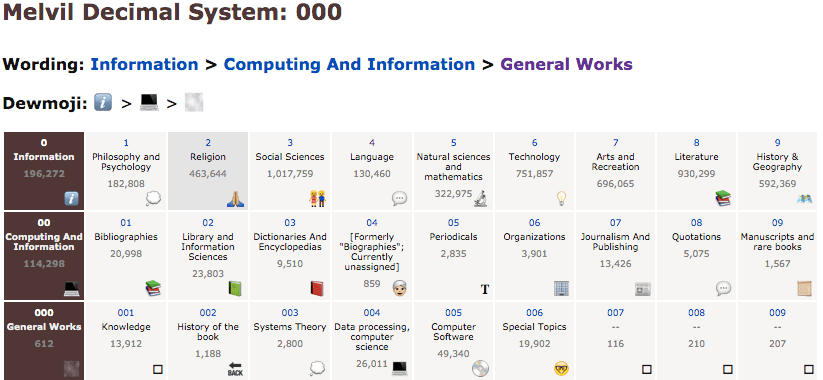
Yet, this same system, even in its twenty-third year of incarnation, devotes an entire section (the 630s) to agriculture, and a full 3 digit number (682) to black smithing (I have yet to meet a black smith face-to-face, but have encountered them in some Dickens tales). Ultimately, this whole set up is like trying to stuff all your jeans and pants into a single small cubby hole in your closet, while leaving a long rack just for your raincoat – it’s illogical management of materials.
Facing Historical Bias: DDC as hegemony
Another issue with DDC is its discriminatory treatment of historically marginalized groups; specifically, homosexuals, women, non-Christian religions, and developing countries. Dewey devised a system which favoured a Protestant, patriarchal, puritanical worldview, the dominant societal values for the time and place in which it was created. As such, the 200s devotes itself almost entirely to Christianity, leaving the 290s to all other religions. Commenting on a similar cultural bias, Library Supervisor, Andrew Goodson writes, “And, within literature, everything outside of western European languages starts with 890; all of “African literature” gets a single 3 digit number (896), the same as “Classical Greek lyric poetry” (884)” In regards to the treatment of homosexuality, Doreen Sullivan writes:
“Once upon a time and yet not so long ago, LGBTI (lesbian, gay, bisexual, transgender and intersex) topics have variously been assigned to DDC categories such as Abnormal Psychology, Perversion, Derangement, as a Social Problem and even as Medical Disorders. Is it any wonder that someone browsing ‘similar’ library items in this area could feel alienated?”
https://overland.org.au/2015/07/a-brief-history-of-homophobia-in-dewey-decimal-classification/
Some may argue that DDC is simply a reflection of the views and values of the society in which it exists, adapting alongside the world’s advancement of human rights and attitudes, to which there may be some merit. Although, in her extensive inquiry into the historical treatment of gays and lesbians by the DDC, librarian, Shelly Drumm maintains that the DDC represents the intellectual elite and in its hegemonic endeavours to label and identify, can instruct and influence acceptable cultural norms. So, while a system may be only as good as its society, it is noteworthy that in 1979, ten years after the Stonewall Riots, “Homosexuality is still classed with prostitution, incest and extramarital relations […]” (http://drumm.info/naming-the-love/). At the time she wrote her article, in 2000, she notes that “[i]n the DDC20, gay marriage made an appearance, but it was then under the heading of “Institutions pertaining to the relations of the sexes” and not under the morally affirming heading of “Marriage and Family.”
So, what’s the answer?
In a 2009 PLA blog (Public Library Association), Laena McCarthy put out a call for a new library classification system that would replace DDC, called the Open Shelves Classification (OSC). Unfortunately, it did not seem to gain the momentum it needed, and research of its development leads to inactivity and dead links. What it did point to, though, was a collaborative desire to replace an archaic system with, what the activating team described as, “a free, ‘humble,’ modern, open-source, crowd-sourced” one. The project’s demise also points to the magnitude of such an endeavour.
Some libraries have adopted a system similar to that of BISAC (the bookstore system), which is under copyright. This style of Dewy-free classification eliminates any need for numerical notation. However, I know that I’ve stood staring at a section in a book store, unable to find the title I was looking for, even though the computer swore it was in stock. Nonetheless, I still like the ease and idea of simple word signage to denote subjects. Most university libraries use the 21 class system of the LCC (Library of Congress Classification), so university destined students will not be missing any prerequisites on how to navigate a library.
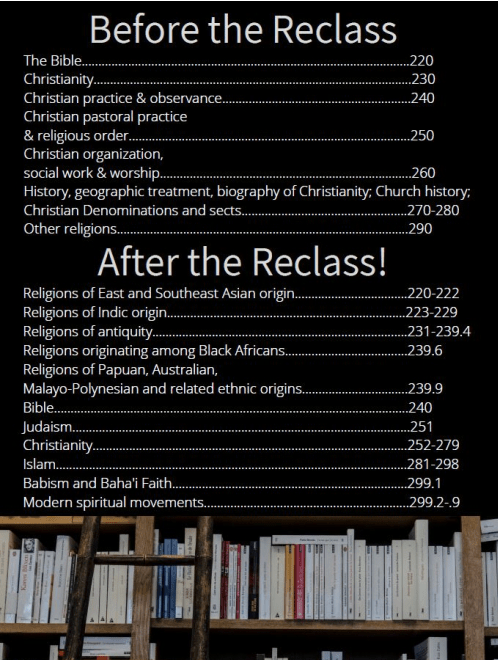
Simmons University, in Boston, took the outdated 200s (Religion), and completely revamped it on their own to be more inclusive and relevant to a patron in 2020. Check it out:
If given the opportunity to update a school’s library system, I would take a collaborative approach, dare I say, strike a committee, and get to work on categories that make sense to everyone based on our library’s existing collection. Being married to an institution such as DDC is not only unnecessary to today’s learners, but potentially contrary to modern-day logic and sensibilities.
 Randi Solomon
I was just watching a 60 Mimutes episode featuring autonomous trucks. Although today that seems scary and absurd,the fact is industries,systems and technology need to evolve to keep up with today’s world. This is well written and should definitely be explored. Great article!
Thank you teacherfan!!
Very thought provoking article. While personally being a Dewey fan.
While being a fan of the DDC, I found this article to be quite thought provoking and well written.