
There’s something I need to discuss that’s been keeping me up at night. I’ve got a literal pain in my neck that makes finding comfort a bit like a game of Where’s Waldo (Waldo of course being the elusive neutral zone, where sleep has a fighting chance). The culprit of the pain in my neck, I’ve deduced, can only be the mammogram I had almost a week ago. Now before you start yelling at me through your screen, “Toughen up buttercup. That tool prevents breasts cancer! A helluva lot worse than a pain in the neck. Deadlier too.” I know. And the statistics aren’t good. One in eight women in Canada will be diagnosed in their lifetime. And no one wants to be lumped into that chilling statistic. But callous pun aside, can we discuss this like grown women?
I’ve had a total of three mammograms. I’m 52 and have type 1 diabetes, a disease that likes company. Look up almost any ailment under any medical website, and invariably having diabetes will increase the risk of blank. So, wisely, my real MD has had me going for tests that non-diabetics may not begin until they are older.
My first mammogram at 45 somehow didn’t seem that bad. I mean, it wasn’t pleasant, but that moment of awkward, painful stillness was tolerable. And I had the attitude that I suspect is common amongst women: what’s some uncomfortable maneuvering of my body and contortion of my breasts at the hands of a complete stranger in exchange for a cancer-free scan?
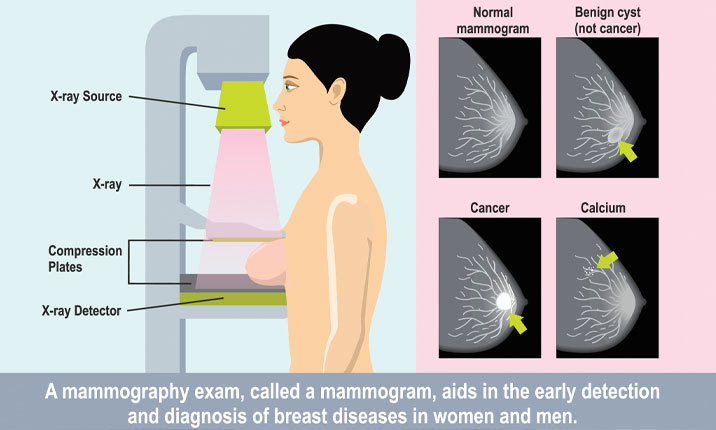
At my second visit, however, remembering that first time, with the lens of my relatively young age and overall sound fitness in mind, sitting with about six other women in the waiting room, all of us wearing the blue hospital scrubs in exchange of our usual chest covers and garments, I thought about them. I noticed the average age was around 65, and estimated a possible octogenarian in the group. My breasts aren’t overly large, but they aren’t small. They’ve been stretched and used through two pregnancies and stints of providing nutrition. How do small breasted women manage? I thought. And how do older women with more delicate bones not leave without lasting bruises and sore bodies? Having met that machine before, it didn’t seem to be a fair fight.
Technicians do their best. I haven’t encountered one unpleasant, unsmiling, unkind one yet. In fact, they seem to know how to meld one’s greater breast area with that contraption expertly. Although, don’t try to play interference. On my third visit, a familiarity with the procedure, and one side having been completed, I had the audacity to move my second breast into what I deemed to be the proper position. I was met with a gentle reprimand, “I move the breast.” The machine is super sensitive. It will not cooperate unless everything is precise. Hold still. Don’t breathe. One more second. Okay, relax. Really? With all the millions of dollars that go into breast cancer research, this is as good as it gets? Who made this machine anyway?
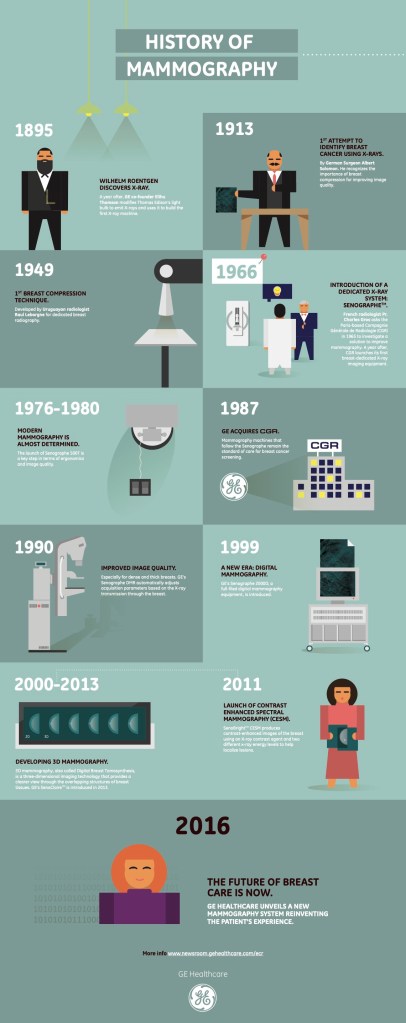
https://www.gehealthcare.com/static/pulse/uploads/2016/03/mamography-final.pdf
So while compressing each breast between a glass vice for your photo op, the body unnaturally comes along for the ride. Shoulders are pushed down and away as far as they can go, head is cocked, rib cage is protectively engaged, spine is curled, legs are planted at a precise distance. It’s like no game of Twister you’ve ever played.
Explanations abound online from breast imaging clinics and doctors alike about why compression is necessary, almost to the point of defensiveness. It’s no secret that the exam elicits fear and avoidance, putting people at risk of missing early detection. Yet the efficacy of this type of screening makes you wonder why it’s the gold standard.
Advisory Board, a U.S. think tank based in Washington DC and founded in 1979 “to discover the best ideas in healthcare,” cites that approximately one in five cancers are missed by screening mammograms, and individuals with dense breast tissue run the stress of false positives, prompting more testing and anxiety.
I have an app that I downloaded onto my phone for free. It’s incredible. I can take a picture of my dog, a vase, an apple, and it can remove the entire background within 2 to 3 seconds of a swipe. That’s cool. I’m no scientist, biologist, or medical expert of any type, but can’t we just take a picture and remove the background? Shouldn’t there be better alternatives to isolating cancerous tissue from healthy tissue? Aren’t there markers in the blood that can suggest whether there are tumours in the breasts? I know, I know, it’s a little more complicated than that. Breasts are complicated fatty, fibrous, tissue-filled organs. Taking a good picture of them is evidently not easy.
I do wonder that if men were expected to compress their testicles between two plates to check on the health of their scrotums, whether modern medicine would advance more aggressively. As it is, a professional medical site in the UK tells its male readers in the very first sentence about tests for testicular cancer that “a scrotal ultrasound scan is a painless procedure that uses high-frequency sound waves to produce an image of the inside of your testicle.” (My italics.)
In their blog post from January 2018, Advisory Board explores the pros and cons to alternatives to mammograms. They also note up-and-coming technologies such as molecular breast imaging (also known as breast-specific gamma imaging) and thermography, the latter of which “uses a camera to measure the temperature of the patient’s skin to determine if cancer cells are growing or multiplying in the breast.”
The problem, as I see it, is in part about advocacy. The medical community in Canada is working out of the system that it can afford, and established practices are not easily met with disruption. As well, there does not seem to be one standard for preventative practice. European Breast Guidelines suggests less frequent mammograms than in the U.S. And while a patient may have more options in the U.S., access is often times dependant on financial means, a disparity which Canadian provinces will hopefully continue to reject.
But what about all the women in those blue hospital gowns, waiting to undergo an onerous and problematic test where even a recent vaccination can cause a false positive? Lay people have, in general, become better at advocating for their personal health in recent decades, educating themselves about mental and physical wellness. But when it comes to the mighty establishment of cancer prevention and treatment, do fear and compliance still lead? Those of us having these screenings were born around 1970 and earlier. We still remember when cancer was a word only whispered. Perhaps as the next generation ages, in particular the women, who were not raised to clear the table while their brothers looked on, will feel at ease with questioning and pushing for the whole patient, and all of her/their needs.
In the meantime, I’m taking the advice of Dr. Google for my pinched neck. Rest and time.
 Randi Solomon