
March 20, 2020
Updated: March 23, 2020
By Randi Solomon
It’s not an easy time to be in a decision-making governmental role. Being in a state of emergency or equivalency thrusts many of our provincial leaders into essential roles with unprecedented weight, come what may.
In the past week, the provinces’ Ministries of Education have responded to the realities of COVID 19 in varied ways. Here’s a look at and evaluation of 5 of the largest provinces’ performances during this extraordinary time.
Alberta
- As of March 17, schools are indefinitely closed
- Provincial Achievement Test (PAT) is cancelled for the year
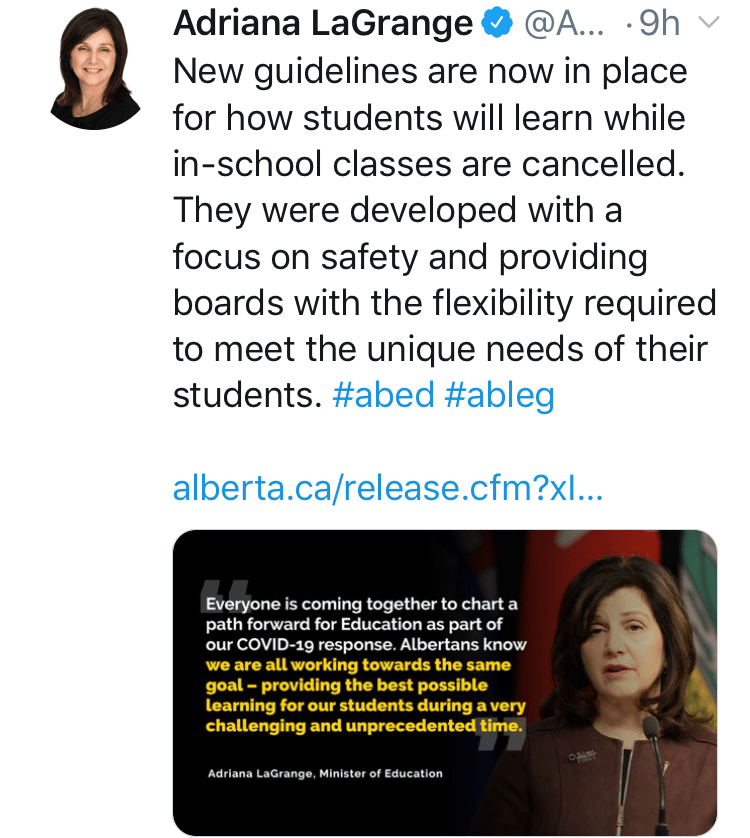
- Minister Adriana LaGrange is working with the Ministry of Advanced Education to determine diploma requirements and transition needs for graduating students
- Grand Prairie Public School District is compiling online resources for 3 areas of learning
- K-8 literacy and numeracy resources
- 9-12 resources and supports
- parent resources for physical education, art, health and personal development
- Teachers are on the job, with a work at home option
- Districts, ministry and school divisions are working together on a plan for students
- March 20 – new comprehensive guidelines are announced for at home learning
British Columbia
- As of March 17, schools are closed
- Diploma acquisition and graduation has yet to be determined
- Ministry is working with post-secondary institutions
- Ministry is working with teachers and districts to offer alternatives to learning
- Minister is urging districts and schools to begin planning online now for continuity
- Superintendents have been in discussions with Minister of Education about next steps
- Teri Mooring, president of BCTF, has said there is a high level of cooperation with government
- Minister of Education, Rob Fleming has said, “We will continue to work in consultation with our education partners as we plan how we will provide ongoing education services. We’ll be in frequent contact with school districts and the school authorities to ensure that we work through this challenge together.”
Manitoba
- First school closed on March 12 (Sandy Bay First Nation, 130 km northwest of Winnipeg)
- As of March 13, province announces 3 week closure for all schools until April 6
- Teachers remain on the job, given first week of closure for preparing and sending home learning materials to students
- Minister of Education, Kelvin Goertzen is asking schools to “consider implementing virtual or online classrooms”
Quebec
- As of March 13, all schools are closed for a two week period
- As of March 20, Premier Francois Legault says it is unlikely schools will reopen by March 16 and says it’s looking like the beginning of May
- no plans released about home learning for students
Ontario
- As of March 12, schools are closed for two weeks after March break, to reopen April 6 (students and staff to remain at home during closure)
- March 18 – OSSLT / EQAO is cancelled for the year and no longer a graduation requirement for students affected this academic year
- March 18 – OSSTF suspends any strike action amidst COVID19
- OSSTF President, Harvey Bischof writes to Minister to offer full cooperation and support; urges ministry to consult with OSSTF before implementing plans
- YRDSB and TDSB and other school boards, in the meantime, have added extensive resources to their websites
- March 20 – Ministry launches learnathome.ca portal to offer interactive learning tools in line with K-12 curriculum using what they call “certified tutors”
- adds educational content on TVO
- Minister of Education, Stephen Lecce, tweets that he is in conversation with Sarah Thomson, President of Ontario Federation of Home and School Associations, Inc., to help support students
- no explicit direction or collaboration from ministry with school boards/teachers as of March 20

Final Marks
A +
The BC and Alberta governments are working closely with their teachers and boards to ensure meaningful continuation of educational services and resources.
Suggested Next Steps: Continue to collaborate in an effective manner to help support ongoing student learning.
B –
Manitoba has good faith that their teachers have resource capacity to offer online learning alternatives.
Suggested Next Steps: Devise some concrete plans for offering online tools visa vie existing teacher and school expertise and experience.
C – B (upgraded as of March 23 – letter to all families distributed)
Ontario seems disconnected with its teachers and unions by providing no clear direction as of yet on how educators can support at home student learning. Instead, they are going at it alone, or consulting new stakeholders.
Suggested Next Steps: Work on collaborating with others, especially those who have a keen knowledge and understanding of the curriculum and their students.
D
Quebec is not yet seemingly discussing at home learning options.
Suggested Next Steps: Begin to plan for at home learning for students in your province.
 Randi Solomon